TRANSLATION MATRIX
Definition Of Translation Matrix
A matrix representing a translated figure is a Translation matrix
Examples of Translation Matrix
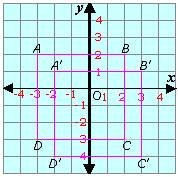
- A'B'C'D' is the translation matrix of ABCD.
Video Examples: Matrix Translations
Solved Example on Translation Matrix
Ques: Express the translation of triangle ABC as the sum of a polygon matrix and a translation matrix.
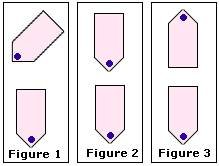
Choices:

Correct Answer: A
Solution:
Step 1:Identify the coordinates of ABC and A'B'C'.
Step 2: The coordinates of ABC are A(- 3, 4), B(- 1, 2) and C(- 3, 2).
Step 3: The vertices of ABC in matrix form is
A B C

Step 4: The coordinates of A'B'C' are A'(1, - 2), B'(3, - 4) and C'(1, - 4).
Step 5: The vertices of A'B'C' in matrix form is
A' B' C'

Step 6: Coordinates of image - Coordinates of pre image = Coordinates of the translation vector.
Step 7: The translation that maps ABC to A'B'C is 4 units left and 6 units down.
Step 8: Vertices of pre image + Translation matrix = Vertices of image.
Step 9: - = 
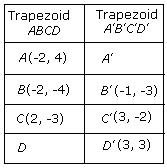
Ques: Find the coordinates of D and A' of the translation matrix of trapezoid. A table of the vertices of each trapezoid is shown below.
A. D(2, 2), A'(- 1, 5)
B. D(2, - 2), A'(- 1, 5)
C. D(- 2, - 2), A'(- 1, 5)
D. D(2, 2), A'(- 1, - 5)
Correct Answer: A
Solution:
Step 1:Let (a, b) represent the coordinates of D and (c, d) represent the coordinates of A'.
Step 2: Write the coordinates as a matrix equation.

Step 3: 
Step 4:Solve an equation for x and y.
-2 + x = -1 Þ x = -1 + 2 Þ x = 1
-4 + y = -3 Þ y = -3 + 4 Þ y = 1
[Since, if two matrices are equal then their corresponding elements are equal.]
Step 5: Solve the equations for a, b, c, and d using the values x = 1 and y = 1.
a + x = 3 Þ a + 1 = 3 Þ a = 3 - 1 Þ a = 2
b + y = 3 Þ b + 1 = 3 Þ b = 3 - 1 Þ b = 2
-2 + x = c Þ -2 + 1 = c Þ c = -1
4 + y = d Þ 4 + 1 = d Þ d = 5
Step 6: So, the coordinates of D(a, b) and A'(c, d) are D(2, 2) and A'(-1, 5).
Quick Summary
- A translation matrix shifts points in a coordinate system.
- It is used to move figures without rotating or resizing them.
- In 2D, it's often represented as a 3x3 matrix using homogeneous coordinates.
- The translation vector (tx, ty) determines the magnitude and direction of the shift.
🍎 Teacher Insights
Use visual aids to demonstrate the effect of translation matrices. Start with simple examples and gradually increase the complexity. Emphasize the importance of homogeneous coordinates for combining transformations.🎓 Prerequisites
- Matrix operations
- Coordinate geometry
- Vector addition
Check Your Knowledge
Q1: Which matrix represents a translation of (2, -3)?
Q2: What does a translation matrix do?
Frequently Asked Questions
Q: What are homogeneous coordinates?
A: Homogeneous coordinates are a way to represent points in N-dimensional space using N+1 coordinates. This allows translation to be represented as a matrix multiplication.
Q: How do I create a translation matrix for a specific translation?
A: For a translation of (tx, ty) in 2D, the translation matrix is [[1, 0, tx], [0, 1, ty], [0, 0, 1]].