SAS SIMILARITY POSTULATE
Definition Of SAS Similarity Postulate
SAS Similarity Postulate states, "If an angle of one triangle is congruent to the corresponding angle of another triangle and the sides that include this angle are proportional, then the two triangles are similar."
Example of SAS Similarity Postulate
The triangles shown are similar as their corresponding angle is congruent and the sides including this angle are proportional. i.e,.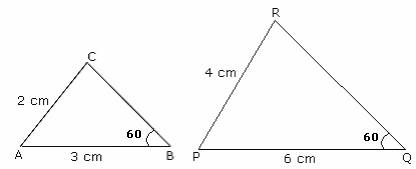
The triangles shown are similar as their corresponding angle is congruent and the sides including this angle are proportional. i.e, 
Video Examples: Notes SAS Similarity Theorem
Solved Example on SAS Similarity Postulate
Ques: Identify the postulate, based on which the given pair of triangles can be said similar?

Choices:
A. SSS similarity postulate
B. SAS similarity postulate
C. AA similarity postulate
D. None of the above
Correct Answer: B
Solution:
Step 1: From the figure, ΔABC and ΔPQR are similar by SAS postulate as and ∠A = ∠P.
Step 2: So, the given triangles are similar by SAS similarity postulate.
Quick Summary
- SAS Similarity Postulate states conditions for triangles to be similar.
- Requires one pair of congruent corresponding angles.
- Requires the sides including the angle to be proportional.
🍎 Teacher Insights
Use diagrams and visual aids to illustrate the postulate. Emphasize the difference between congruence and similarity. Provide examples with varying orientations of triangles.🎓 Prerequisites
- Congruent angles
- Proportional sides
- Similar triangles
- Basic algebra
Check Your Knowledge
Q1: Which postulate can be used to prove that the two triangles are similar if \(\angle A = \angle D\), AB = 4, AC = 6, DE = 8, and DF = 12?
Q2: If two triangles have one pair of congruent angles, what else is needed to prove similarity by SAS?
Frequently Asked Questions
Q: How is SAS Similarity different from SAS Congruence?
A: SAS Similarity requires proportional sides and a congruent angle, while SAS Congruence requires congruent sides and a congruent angle.
Q: Do the proportional sides have to be adjacent to the congruent angle?
A: Yes, the proportional sides must include (be adjacent to) the congruent angle.