SAA CONGRUENCY POSTULATE
Definition Of SAA Congruency Postulate
If two angles and the included side of one triangle are congruent to the two angles and the included side of another triangle, then the two triangles are congruent.
More About SAA Congruency Postulate
SAA postulate can also be called as AAS postulate.
The side between two angles of a triangle is called the included side of the triangle.
SAA postulate is one of the conditions for any two triangles to be congruent.
Video Examples: SAA Congruency Postulate
Example of SAA Congruency Postulate
The triangles ABC and PQR are congruent, i.e., ΔABC ≅ ΔPQR, since ∠CAB = ∠RPQ, AC = PR, and ∠ABC = ∠PQR.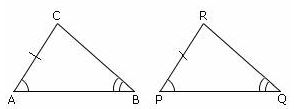
Solved Example on SAA Congruency Postulate
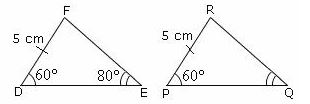
Ques: If the two triangles given are congruent by SAA postulate then identify the value of angle Q.
Choices:
A. 80°
B. 60°
C. 75°
D. 70°
Correct Answer: A
Solution:
Step 1: If two angles and the non-included side of one triangle is congruent to
two angles and the non-included side of another triangle then the two triangles are congruent by SAA postulate.
Step 2: As the given triangles are congruent by SAA postulate
∠FDE = ∠RPQ, DF= PR, and ∠DEF = ∠PQR.
Step 3: And given ∠DEF = 80° it implies ∠PQR = 80° by SAA postulate.
Quick Summary
- SAA postulate is a condition for triangle congruence.
- It states that if two angles and the non-included side of one triangle are equal to the corresponding two angles and the non-included side of another triangle, the triangles are congruent.
- SAA is equivalent to AAS (Angle-Angle-Side).
🍎 Teacher Insights
Use visual aids and hands-on activities to demonstrate the SAA postulate. Emphasize the difference between included and non-included sides. Provide ample practice problems where students have to identify congruent triangles using SAA.🎓 Prerequisites
- Understanding of angles and sides of a triangle
- Definition of congruent angles and sides
- Basic triangle properties
Check Your Knowledge
Q1: If triangle ABC has angle A = 60 degrees, angle B = 80 degrees, and side BC = 5 cm, and triangle PQR has angle P = 60 degrees, angle Q = 80 degrees, and side QR = 5 cm, are the triangles congruent by SAA?
Q2: Which of the following conditions is sufficient to prove triangle congruence using SAA postulate?
Frequently Asked Questions
Q: What is the difference between SAA and ASA congruence postulates?
A: In ASA, the side is included between the two angles, whereas in SAA, the side is NOT included between the two angles.
Q: Is SAA the same as AAS?
A: Yes, SAA (Side-Angle-Angle) is the same as AAS (Angle-Angle-Side). The order in which the angles and side are listed does not matter as long as the side is non-included.