RULE
Definition Of Rule
Row Matrix is a matrix with only one row.
Example of Rule
7, 16, 43,... is the pattern for which the rule is "Multiply by 3 and subtract by 5 to get the next number" as each number is obtained by multiplying by 3 and then subtracting the result by 5 to get the next number
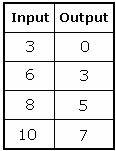
The first value in the input column is 3 and the output is 0. This is obtained by adding 2 to the input value and subtracting 5 from the result, i.e. 3 + 2 = 5 - 5 = 0.
The second value in the input column is 6 and the output is 3. This is obtained by adding 2 to the input value and subtracting 5 from the resultant value, i.e. 3 + 2 = 5 - 5 = 0
The third value in the input column is 8 and the output is 5. This is obtained by adding 2 to the input value and subtracting 5 from the resultant value, i.e. 8 + 2 = 10 - 5 = 5
The fourth value in the input column is 10 and the output is 7. This is obtained by adding 2 to the input value and subtracting 5 from the resultant value, i.e. 10 + 2 = 12 - 5 = 7.
Video Examples: Rule
Solved Example on Rule
Ques: What is the rule for the table?
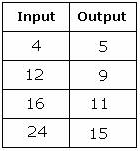
Choices:
A. Add 2 and multiply by 1
B. Multiply by 2 and subtract 2
C. Subtract 2 and add 4
D. Divide by 2 and add 3
Correct Answer: A
Solution:
Step 1: Consider the first input value given in the table and try each rule on the value to check if we get the corresponding output value
Step 2: Consider 4, (4 + 2) × 1 = 6, not 5. So, choice 1 does not work
Step 3: (4 × 2) - 2 = 6, not 5. So, choice 2 does not work
Step 4: (4 - 2) + 4 = 6, not 5. So, choice 3 does not work
Step 5: (4 ÷ 2) + 3 = 5, choice 4 works
Step 6: So, 'divide by 2 and add 3' is the rule for the table
Quick Summary
- A rule describes how to get from one number or value to another.
- Rules can involve one or more mathematical operations.
- Identifying the rule allows you to predict future values in a pattern.
🍎 Teacher Insights
Start with simple patterns involving single operations. Use visual aids like number lines or manipulatives to help students visualize the relationships.🎓 Prerequisites
- Basic arithmetic operations (addition, subtraction, multiplication, division)
- Understanding of variables (optional)
Check Your Knowledge
Q1: What is the rule for the pattern 2, 4, 6, 8?
Q2: What is the rule for the following table? Input | Output 3 | 5 4 | 6 5 | 7
Frequently Asked Questions
Q: How do I find the rule?
A: Look for a consistent relationship between the inputs and outputs. Try different operations until you find one that works for all the given values.
Q: Can a pattern have more than one rule?
A: No, a pattern has one specific rule.