RIGHT TRIANGLE
Definition Of Right Triangle
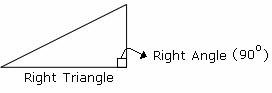
A triangle with one of its angles measuring 90° (i.e. a right angle) is called a Right Triangle.
More about Right Triangle
Right triangle is also called as right-angled triangle.
In a right triangle, the side opposite to the right angle is the hypotenuse of the triangle and happens to be the longest side. The other two sides are called the
legs of the right triangle.
A right triangle always satisfies the Pythagorean theorem i.e. if h is the hypotenuse length, b is the base length, and p is the perpendicular length in a right triangle, then h2 = b2 + p2
Video Examples: Right Triangle Trigonometry
Examples of Right Triangle
Solved Example on Right Triangle
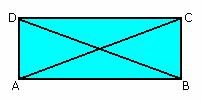
Ques: Which of the following figures is a right prism?
Choices:
A. 4
B. 2
C. 1
D. 3
Correct Answer: A
Solution:
Step 1: In a triangle, if any of the three angles measures 90°, then the triangle is right triangle
Step 2: In the given figure, there are 4 right triangles and they are ΔABC with ∠B = 90°,
ΔBCD with ∠C = 90°, ΔCDA with ∠D = 90° and ΔDAB with ∠A = 90°
Step 3: Hence, there are 4 right triangles in the given rectangle.
Quick Summary
- One angle is 90 degrees.
- The side opposite the right angle is the hypotenuse.
- The hypotenuse is the longest side.
- The other two sides are called legs.
- Satisfies the Pythagorean Theorem: a^2 + b^2 = c^2
🍎 Teacher Insights
Use visual aids and real-world examples to illustrate right triangles. Emphasize the correct identification of the hypotenuse and legs. Provide ample practice problems for applying the Pythagorean Theorem.🎓 Prerequisites
- Basic Triangle Properties
- Angles
- Pythagorean Theorem (Introduction)
Check Your Knowledge
Q1: Which of the following sets of side lengths could form a right triangle?
Q2: In a right triangle, if the legs are 6 and 8, what is the length of the hypotenuse?
Frequently Asked Questions
Q: What is the longest side of a right triangle called?
A: The hypotenuse.
Q: How can I identify a right triangle?
A: Look for a 90-degree angle, often marked with a small square.
Q: Does the Pythagorean theorem apply to all triangles?
A: No, only to right triangles.