RHOMBUS
Definition Of Rhombus
Rhombus is a parallelogram with four equal sides.
More about Rhombus
Diagonals of a rhombus bisect each other at right angles.
Diagonals of a rhombus bisect opposite angles.
Area of a rhombus (A) with side length l and perpendicular distance h between opposite sides is given as A = lh
Video Examples: Properties of a Rhombus
Example of Rhombus
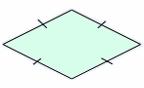
The given figure represents a rhombus.
Solved Example on Rhombus
Ques: ABCD is a rhombus. Find the area of ABCD, if AC = 3 in. and BD = 4 in.
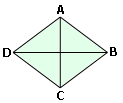
Choices:
A. 9 in.2
B. 6 in.2
C. 7 in.2
D. 8 in.2
Correct Answer: B
Solution:
Step 1: Area of rhombus = 1/2 × product of diagonals
Step 2: AC = 3 in. and BD = 4 in. [Given.]
Step 3: Area of ABCD = 1/2 × AC × BD
Step 4: = 1/2 × 3 × 4
Step 5: = 12 / 2 = 6 [Substitute AC = 3 and BD = 4.]
Step 6: The area of ABCD = 6 in.2.
Quick Summary
- Rhombus is a parallelogram with four equal sides.
- Diagonals bisect each other at right angles.
- Diagonals bisect opposite angles.
- Area = side length * perpendicular distance between opposite sides.
🍎 Teacher Insights
Use physical models and diagrams to illustrate the properties of a rhombus. Emphasize the relationship between rhombuses, parallelograms, and squares.🎓 Prerequisites
- Parallelograms
- Angles
- Lines
- Area
Check Your Knowledge
Q1: Which of the following is always true about a rhombus?
Q2: The diagonals of a rhombus bisect each other at what angle?
Frequently Asked Questions
Q: Are all rhombuses squares?
A: No, a square is a special type of rhombus with four right angles. A rhombus only needs to have four equal sides.
Q: Do the diagonals of a rhombus have equal length?
A: No, the diagonals of a rhombus are not necessarily equal in length. They are only equal in the special case of a square.