RATIONAL FUNCTIONS
Definition Of Rational Functions
The functions of the form  where P(x) and Q (x) are the polynomial function in x and Q (x) ≠ 0, are called as Rational Functions.
More About Rational Functions
The degree of a rational function is the maximum of the degrees of its constituent functions.
Examples of Rational Functions
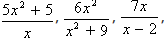 , etc are the examples of rational functions.
Video Examples: Rational Functions
Solved Example on Rational Functions
Ques: Which of the following is a rational function?
Choices:
A. f(x) = 
B. f(x) = 
C. f(x) = 
D. f(x) = 
Correct Answer: C
Solution:
Step 1: A function of the form  , where P(x) and Q(x) are polynomials and Q(x) ? 0 is known as a rational function.
Step 2: f(x) = is not a rational function, since is not a polynomial.
Step 3: f(x) = is not a rational function, since  is not a polynomial.
Step 4: f(x) = is not a polynomial, so f(x) is not a rational function.
Step 5: f(x) = is a rational function. [Both numerator and denominator expressions are polynomials.]
Quick Summary
- Rational functions are ratios of two polynomials.
- The denominator of a rational function cannot be equal to zero.
- The degree of a rational function is the maximum of the degrees of its constituent polynomials.
🍎 Teacher Insights
Emphasize the importance of identifying values that make the denominator zero. Use graphing tools to visualize the behavior of rational functions near asymptotes and holes.🎓 Prerequisites
- Polynomials
- Algebraic Expressions
- Domain and Range of a Function
Check Your Knowledge
Q1: Which of the following is a rational function?
Q2: What is the domain of f(x) = 1 / (x - 3)?
Frequently Asked Questions
Q: What happens when the denominator of a rational function is zero?
A: The function is undefined at that point. This creates a vertical asymptote or a hole in the graph of the function.
Q: How do you find the domain of a rational function?
A: The domain includes all real numbers except for the values of x that make the denominator equal to zero.