QUARTILES
Definition Of Quartiles
Quartiles are values that divide a set of data into four equal parts.
More About Quartiles
A data set has three quartiles: the lower quartile, the median of the data set, and the upper quartile
Median: The median divides a data set into two equal parts.
Lower quartile: Median of the lower half of the data.
Upper quartile: Median of the upper half of the data.
Video Examples: How to Find Quartiles in Math
Examples of Quartiles
The owner of a super market recorded the number of customers who came into his store each hour in a day.
The results were 12, 8, 10, 7, 15, 3, 6, 7, 12, 8, and 9.
The ascending order of the data is 3, 6, 7, 7, 8, 8, 9, 10, 12, 12, 15.
The lower quartile is 7, the median is 8, and the upper quartile is 12.
Solved Example on Quartiles
Ques: What is the product of all the three quartiles of the box-and-whisker plot shown?
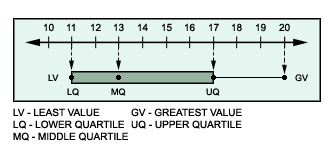
Choices:
A. 2,050
B. 2,431
C. 1,234
D. 41
Correct Answer: B
Solution:
Step 1: The middle quartile = 13 and the upper quartile = 17.
Step 2: The product of all the three quartiles
= lower quartile × middle quartile × upper quartile
= 11 × 13 × 17 = 2,431 [Multiply.]
Quick Summary
- Quartiles divide a data set into four equal parts.
- There are three quartiles: lower quartile (Q1), median (Q2), and upper quartile (Q3).
- The median is the middle value of the data set.
- The lower quartile is the median of the lower half of the data.
- The upper quartile is the median of the upper half of the data.
🍎 Teacher Insights
Emphasize the importance of ordering the data set correctly before finding the quartiles. Use real-world examples to illustrate the application of quartiles.🎓 Prerequisites
- Median
- Data Sets
- Ascending Order
Check Your Knowledge
Q1: What divides a dataset into two equal parts?
Q2: The lower quartile is the median of which part of the data?
Frequently Asked Questions
Q: What is the interquartile range (IQR)?
A: The interquartile range (IQR) is the difference between the upper quartile (Q3) and the lower quartile (Q1). IQR = Q3 - Q1
Q: How are quartiles used in box plots?
A: Quartiles are used to create box plots, which visually represent the distribution of data. The box extends from Q1 to Q3, with a line at the median (Q2). Whiskers extend to the minimum and maximum values within a certain range.