POINT OF DISCONTINUITY
Definition Of Point Of Discontinuity
A function is said to have a point of discontinuity at x = a or the graph of the function has a hole at x = a, if the original function is undefined for x = a, whereas the related rational expression of the function in simplest form is defined for x = a.
Video Examples: Finding Discontinuities of Rational Functions
Example of Point of Discontinuity
Consider a function 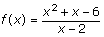 .
.
This function is undefined for x = 2. But the simplified rational expression of this
function, x + 3 which is obtained by canceling (x - 2) both in the numerator and the denominator is
defined at x = 2. Thus we can say that the function f(x) has a point of discontinuity at x = 2.
Solved Example on Point of Discontinuity
Ques: Which of the following would replace the blank so that the rational function 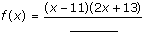 will have a point discontinuity?
Choices:
A. x - 11
B. 2x + 13
C. Either A or B
D. x + 1
Correct Answer: C
Solution:
Step 1: The function will have a point discontinuity if the denominator contains either of the binomials (x - 11) or (2x + 13).
Quick Summary
- Point discontinuities occur when a factor cancels from both the numerator and denominator of a rational function.
- These discontinuities are also known as removable discontinuities.
- The graph of the function has a 'hole' at the x-value where the discontinuity occurs.
🍎 Teacher Insights
Emphasize the simplification of rational functions. Use graphing calculators to visualize the 'holes' in the graph at the point of discontinuity. Present both algebraic and graphical approaches.🎓 Prerequisites
- Limits
- Rational Functions
- Factoring Polynomials
Check Your Knowledge
Q1: Which of the following functions has a point discontinuity?
Q2: At what x-value does the function f(x) = \frac{(x+1)(x-3)}{x-3} have a point of discontinuity?
Frequently Asked Questions
Q: How do you find a point of discontinuity?
A: Factor the numerator and denominator of the rational function. If a factor cancels out, then there's a point discontinuity at the x-value that makes that factor equal to zero.
Q: Is a point of discontinuity the same as a vertical asymptote?
A: No. A point of discontinuity (hole) is a removable discontinuity, while a vertical asymptote is a non-removable discontinuity where the function approaches infinity.