PARTIAL FRACTIONS
Definition Of Partial Fractions
When a proper rational expression is decomposed into a sum of two or more rational expressions, it is known as Partial Fractions.
More About Partial Fractions
It is used in integrating rational fractions in calculus and finding the inverse Laplace transform.
In partial fractions the degree of numerator is less than the degree of the denominator.
Examples of Partial Fractions
The rational function  can be decomposed into partial fractions in the following way:
First decompose the fraction into linear factors as
= 
On simplification, x - 4 = A(x + 4) + B(x)
Now, by comparing the coefficients of like terms on both sides, we get,
A + B = 1, 4A = - 4.
On solving the equations, we get, A = - 1, B = 2.
By substituting the values of A and B, we get,
=  .
.
Video Examples: Partial Fraction Expansion 1
Solved Example on Partial Fractions
Ques: Find the partial fraction decomposition of  .
.
Choices:
A. 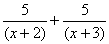
B. 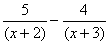
C. 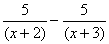
D. none of the above
Correct Answer: C
Solution:
Step 1: = 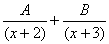
Step 2: = 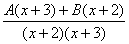
Step 3: = 5 = A(x + 3) + B(x + 2)
Step 4: Then A + B = 0; 3A + 2B = 5 [Compare the coefficients of like terms on both sides.]
Step 5: 
 =
= 
C X = D [Write system of equations in the matrix form as CX = D.]
Step 6: X = C-1D
Step 7: =  [Use Matrix Inversion method.]
Step 8: = -1  [Inverse of
 =
= 
 .]
.]
Step 9: =
Step 10: So, A = 5 and B = - 5
Step 11: So, = .
Quick Summary
- Partial fractions decompose rational expressions.
- Used in calculus for integrating rational functions.
- The degree of the numerator must be less than the degree of the denominator.
🍎 Teacher Insights
Emphasize the importance of correctly factoring the denominator. Provide plenty of practice problems with varying levels of complexity.🎓 Prerequisites
- Algebra
- Rational Expressions
- Polynomials
Check Your Knowledge
Q1: What is the first step in partial fraction decomposition?
Q2: Decompose (5) / ((x+2)(x+3)) into partial fractions.
Frequently Asked Questions
Q: When do I use partial fraction decomposition?
A: When integrating rational functions or finding inverse Laplace transforms.
Q: What if the denominator has repeated factors?
A: You need to include terms for each power of the repeated factor.