PARALLELOGRAM
Definition Of Parallelogram
A Parallelogram is a quadrilateral whose opposite sides are parallel and equal and opposite angles are equal.
More About Parallelogram
The diagonals of a parallelogram bisect each other.
Area (A) of a parallelogram of base b and height h is given as A = bh.
Examples of Parallelogram
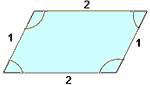
The figure shown above is a parallelogram.
Video Examples: Geometry - Parallelograms
Solved Example on Parallelogram
Ques: Which pair of shapes can be combined to form a parallelogram?
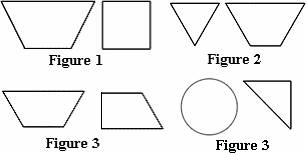
Choices:
A. Figure 1
B. Figure 2
C. Figure 3
D. Figure 4
Correct Answer: B
Solution:
Step 1: A parallelogram is a quadrilateral that has two pairs of parallel sides.
Step 2: Here, we can make a parallelogram with the pair of shapes in the Figure 2.
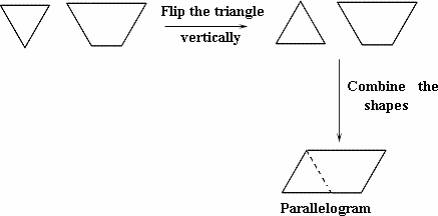
Step 3: So, Figure 2 can be combined to form a parallelogram.
Quick Summary
- Opposite sides are parallel and equal.
- Opposite angles are equal.
- Diagonals bisect each other.
- Area = base x height
🍎 Teacher Insights
Use visual aids and hands-on activities to demonstrate the properties of parallelograms. Emphasize the difference between the height and the side length when calculating the area.🎓 Prerequisites
- Quadrilaterals
- Parallel Lines
- Angles
- Area
Check Your Knowledge
Q1: Which of the following is NOT a property of a parallelogram?
Q2: If a parallelogram has a base of 10cm and a height of 5cm, what is its area?
Frequently Asked Questions
Q: Are all rectangles parallelograms?
A: Yes, all rectangles are parallelograms because they have two pairs of parallel sides. However, not all parallelograms are rectangles because rectangles must have four right angles.
Q: How do you calculate the area of a parallelogram?
A: The area of a parallelogram is calculated by multiplying the base by the height (A = bh). The height must be perpendicular to the base.