OPPOSITE ANGLES
Definition Of Opposite Angles
When two lines intersect, four angles are formed. The angles that are directly opposite to each other are called Opposite Angles.
More About Opposite Angles
Opposite angles are also called vertically opposite angles.
Opposite angles are always non-adjacent.
When two parallel lines are cut by a transversal, 8 angles or 4 pairs of opposite angles are formed.
Example of Opposite Angles
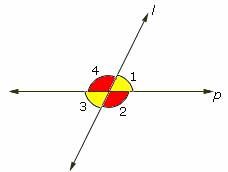
In the given figure, the lines l and p intersect each other and form four angles.
Among these angles, ∠1 and ∠3, ∠2 and ∠4 are opposite angles.
Video Examples: Vertical or Opposite Angles
Solved Example on Opposite Angles
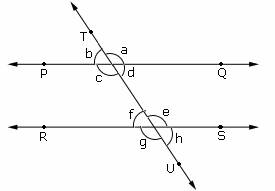
Ques: Find the pairs of opposite angles in the given figure.
Choices:
A. (a, b), (c, d), (e, f), (g, h)
B. (a, e), (b, f), (c, g), (d, h)
C. (a, c), (b, d), (e, g), (f, h)
D. (a, d), (b, c), (e, h), (f, g)
Correct Answer: C
Solution:
Step 1: When two lines intersect, four angles are formed. The angles that are directly opposite to each other are called opposite angles.
Step 2: From the figure, two lines PQ and RS are cut by the transversal TU forming eight angles.
Step 3: So, (a, c), (b, d), (e, g), (f, h) are opposite angles.
Quick Summary
- Opposite angles are formed by intersecting lines.
- Opposite angles are also called vertically opposite angles.
- Opposite angles are non-adjacent.
- Opposite angles are equal in measure.
🍎 Teacher Insights
Use visual aids and hands-on activities to help students understand the concept of opposite angles. Emphasize the difference between opposite, adjacent, and supplementary angles.🎓 Prerequisites
- Understanding of angles
- Understanding of intersecting lines
Check Your Knowledge
Q1: In the given figure, if angle 1 is 60 degrees, what is the measure of its opposite angle?
Q2: Which of the following pairs of angles are opposite angles?
Frequently Asked Questions
Q: Are opposite angles always equal?
A: Yes, opposite angles formed by the intersection of two lines are always equal in measure.
Q: Are opposite angles the same as supplementary angles?
A: No, opposite angles are formed by intersecting lines and are equal. Supplementary angles add up to 180 degrees.