NON SINGULAR MATRIX
Definition Of Non Singular Matrix
If the determinant of a matrix is not equal to zero, then the matrix is called a Non-singular Matrix.
More About Non Singular Matrix
An n x n(square) matrix A is called non-singular if there exists an n x n matrix B such that AB = BA = In, where In denotes the n x n identity matrix.
If the matrix is non-singular, then its inverse exists.
Properties of non-singular matrix:
A. If A and B are non-singular matrices of the same order, then AB is non-singular.
B. If A is non-singular, then Ak is non-singular for any positive integer k.
C. If A is non-singular and k is a non-zero scalar, then kA is non-singular.
Video Examples: Non singular Matrix
Example of Non Singular Matrix
The determinant of  i.e.
i.e.  = 6(3) - 5(2) = 18 - 10 = 8 ≠ 0, so it is a non-singular matrix.
Solved Example on Non-singular Matrix
Ques: Identify the non-singular matrix.
Choices:
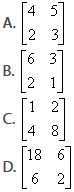
Correct Answer: A
Solution:
Step 1: The determinant of  = 4(3) - 5(2) = 12 - 10 = 2 ≠ 0. Therefore, the matrix is a non-singular matrix.
Step 2: The determinant of the matrix  = 6(1) - 3(2) = 6 - 6 = 0.
Therefore, the matrix is not a non-singular matrix.
Step 3: The determinant of the matrix  = 1(8) - 2(4) = 8 - 8 = 0.
Therefore, the matrix is not a non-singular matrix.
Step 4: The determinant of the matrix  = 18(2) - 6(6) = 36 - 36 = 0.
Therefore, the matrix is also not a non-singular matrix.
Step 5: Hence, the matrix is the only non-singular matrix.
Quick Summary
- A non-singular matrix has a non-zero determinant.
- A non-singular matrix has an inverse.
- If A and B are non-singular, then AB is non-singular.
- If A is non-singular, then A^k is non-singular for any positive integer k.
- If A is non-singular and k is a non-zero scalar, then kA is non-singular.
🍎 Teacher Insights
Emphasize the connection between the determinant and the existence of an inverse. Provide examples of 2x2 and 3x3 matrices to calculate determinants and inverses. Use software or calculators to assist with larger matrices. Highlight the applications of non-singular matrices in solving systems of linear equations.🎓 Prerequisites
- Matrices
- Determinants
- Matrix Multiplication
- Identity Matrix
- Inverse of a Matrix
Check Your Knowledge
Q1: Which of the following matrices is non-singular?
Q2: If a matrix A is non-singular, what is the value of its determinant?
Frequently Asked Questions
Q: What happens if the determinant of a matrix is zero?
A: If the determinant is zero, the matrix is singular and does not have an inverse.
Q: Is every square matrix non-singular?
A: No, only square matrices with non-zero determinants are non-singular.
Q: How do I find the inverse of a non-singular matrix?
A: You can use methods like Gaussian elimination or the adjugate matrix method.