NON EUCLIDEAN GEOMETRY
Definition Of Non Euclidean Geometry
A Non-Euclidean Geometry is a branch of geometry which does not hold parallel postulate. The Non-Euclidean Geometry generally deals in hyperbolic geometry and elliptic geometry.
More About Non Euclidean Geometry
The parallel postulate of Euclidean Geometry is also called as Euclid's fifth postulate.
Non-Euclidean geometry plays an important role in Relativity Theory and the geometry of space time.
Example of Non Euclidean Geometry
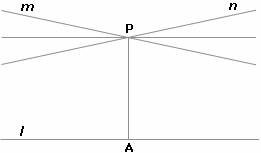
Hyperbolic geometry comes under the non-Euclidean Geometry. As per the hyperbolic geometry, if l is a line and P is a point that does not pass through l, then there are at least two distinct lines which pass through P, but do not intersect l.
Elliptical geometry is also a non-Euclidean Geometry. According to elliptical geometry, if there is a line l and a point P not on the line l, then there is no line which is parallel to l and passes through P.
Video Examples: Non-Euclidean Geometry
Solved Example on Non-Euclidean Geometry
Ques: For the property "Perpendicular lines intersect at one point" from plane Euclidean geometry, identify a corresponding statement for non-Euclidean spherical geometry.
Choices:
A. Perpendicular great circles intersect at four points.
B. Perpendicular great circles do not intersect.
C. Perpendicular great circles intersect at two points.
D. Perpendicular great circles intersect at one point.
Correct Answer: C
Solution:
Step 1: In the plane Euclidean geometry, perpendicular lines intersect at one point.
Step 2: In the non-Euclidean spherical geometry, perpendicular great circles intersect at two points.
Step 3: So, the corresponding statement for the given statement in non-Euclidean spherical geometry is "Perpendicular great circles intersect at two points."
Quick Summary
- Non-Euclidean geometry rejects Euclid's fifth postulate (parallel postulate).
- Hyperbolic geometry: Given a line and a point not on the line, there are at least two distinct lines through the point that do not intersect the given line.
- Elliptic geometry: Given a line and a point not on the line, there are no lines through the point parallel to the given line.
🍎 Teacher Insights
Use physical models (e.g., sphere for elliptic geometry, saddle shape for hyperbolic geometry) to illustrate the concepts. Emphasize the historical context and the shift in mathematical thinking.🎓 Prerequisites
- Euclidean Geometry
- Parallel Postulate
- Set Theory
Check Your Knowledge
Q1: In hyperbolic geometry, if l is a line and P is a point not on l, how many lines exist through P that do not intersect l?
Q2: In elliptic geometry, if l is a line and P is a point not on l, how many lines exist through P that are parallel to l?
Q3: What is a corresponding statement for non-Euclidean spherical geometry regarding perpendicular lines that intersect at one point in plane Euclidean geometry?
Frequently Asked Questions
Q: What is the parallel postulate?
A: Euclid's fifth postulate states that if two lines are drawn which intersect a third in such a way that the sum of the inner angles on one side is less than two right angles, then the two lines inevitably must intersect each other on that side if extended far enough.
Q: Where is Non-Euclidean Geometry used?
A: Non-Euclidean geometry plays an important role in Relativity Theory and the geometry of space time.