MULTIPLICATION OF MATRICES
Definition Of Multiplication Of Matrices
Multiplication of a matrix A = [aij] of order m × n with matrix B = [bij] of n × p is a matrix of order m × p given as C = [cij], where cij = ai 1 . b 1j + ai 2 . b 2j + ai 3 . b 3j + ...+ ain . bnj.
More About Multiplication of Matrices
Matrix multiplication is not commutative.
For any matrices A, B, and C for which the matrix product is defined, and any scalar m, the following properties are true.
Associative Property of matrix multiplication (AB) C = A (BC)
Associative Property of Scalar multiplication m (AB) = (mA) B
Left Distributive Property C (A + B) = CA + CB
Right Distributive Property (A + B) C = AC + BC
Matrix multiplication is possible if and only if the number of columns in the first matrix is equal to the number of rows in the second matrix. 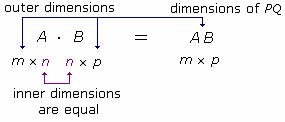
Video Examples: Multiplying Matrices - Example 1
Examples of Multiplication of Matrices
P =  and Q =
As the dimensions of P is 2 × 3 and the dimensions of Q is 3 × 2, the product of P and Q should result in a matrix of dimensions 2 × 2.
PQ =
= 
= 
= 
Solved Example on Multiplication of Matrices
Ques: If P =  and Q =
  , then find QP.
Choices:
A.
B. 
C. 
D. 
Correct Answer = B
Solution:
Step 1: QP =
 =
= 
Step 2: QP = 
Quick Summary
- Matrix multiplication is not commutative (AB ≠ BA).
- Matrix multiplication is associative: (AB)C = A(BC).
- Multiplication is only possible if the number of columns in the first matrix equals the number of rows in the second matrix.
🍎 Teacher Insights
Emphasize the row-by-column approach and the importance of dimensional compatibility. Use visual aids to demonstrate the process.🎓 Prerequisites
- Basic Algebra
- Matrix Representation
- Understanding of Rows and Columns
Check Your Knowledge
Q1: If A is a 2x3 matrix and B is a 3x2 matrix, what are the dimensions of AB?
Q2: Which property is NOT always true for matrices A and B?
Frequently Asked Questions
Q: When is matrix multiplication possible?
A: Matrix multiplication is possible only if the number of columns in the first matrix is equal to the number of rows in the second matrix.
Q: Is matrix multiplication commutative?
A: No, matrix multiplication is generally not commutative. In most cases, AB ≠ BA.