MULTIPLE
Definition Of Multiple
The product of a number with any integer is called the multiple of that number.
More About Multiple
If a number p is multiplied with an integer q, then its multiple (product) n is given as n = p × q
Examples of Multiple
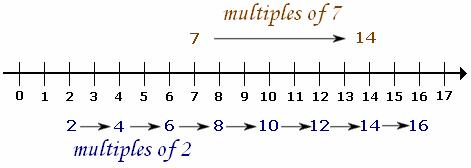
The multiples of 6 are 6, 12, 18, 24, 30, 36, . . . . .
- 36, - 2, 6, 18 are the multiples of 2.
6 is a multiple of 2 and also 3.
Video Examples: Least Common Multiple (LCM)
Solved Example on Multiple
Ques: Find the first seven multiples of 3.
Choices:
A. 3, 9, 6, 16, 19, 22, and 26
B. 6, 9, 12, 16, 19, 22, and 24
C. 3, 6, 9, 12, 15, 18, and 21
D. None of the above
Correct Answer: C
Solution:
Step 1: A multiple of a number is the product of the number with an integer.
Step 2: 1 × 3 = 3
2 × 3 = 6
3 × 3 = 9
4 × 3 = 12
5 × 3 = 15
6 × 3 = 18
7 × 3 = 21 [Write the multiples of 3.]
Step 3: So, the first seven multiples of 3 are 3, 6, 9, 12, 15, 18, and 21.
Quick Summary
- A multiple of a number is the result of multiplying that number by an integer.
- Multiples can be positive or negative.
🍎 Teacher Insights
Use visual aids like number lines or arrays to help students understand the concept of multiples. Relate it to skip counting.🎓 Prerequisites
- Basic Multiplication
- Understanding of Integers
Check Your Knowledge
Q1: Which of the following is a multiple of 4?
Q2: Which of the following is NOT a multiple of 3?
Frequently Asked Questions
Q: What is the difference between a multiple and a factor?
A: A multiple is the result of multiplying a number by an integer. A factor is a number that divides evenly into another number.
Q: Are multiples always positive?
A: No, multiples can be negative if you multiply by a negative integer.