MEMBER OF A SET
Definition Of Member Of A Set
Any element of a set is a member of that set.
More About Member of a Set
The symbol ∈ is used to denote the member of a set.
Member of a set is always the subset of its parent set.
Examples of Member of a Set
Set A= {1, 4, 5, 7, 9, 12} implies that the elements or members of set A are 1, 4, 5, 7, 9, and 12
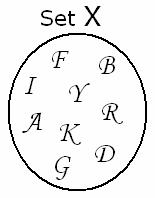
A, B, D, F, G, I, K, R, and Y are the members or the element of set X.
We can write as A ∈ X, B ∈ X, D ∈ X, F ∈ X, G ∈ X, I ∈ X, K ∈ X, R ∈ X, and Y ∈ X.
Video Examples: Difference Between Subset and Member of a set Conceptual
Solved Example on Member of a Set
Ques: ch of the following is a member of the set {A, C, D, F, G, R, T, W, Y}?
Choices:
A. R
B. B
C. P
D. Z
Correct Answer: A
Solution:
Step 1: Any element of a set is a member of that set.
Step 2: Here, only 'R' is a member of the given set.
{A, C, D, F, G, R, T, W, Y} as 'R' is contained in the set.
Quick Summary
- Any element within a set is considered a member of that set.
- The ∈ symbol indicates that an element is a member of a set.
- A member of a set is always a subset of its parent set.
🍎 Teacher Insights
Use real-world examples to illustrate the concept of set membership, such as students in a classroom or items in a shopping cart. Emphasize the distinction between ∈ (member of) and ⊆ (subset of).🎓 Prerequisites
- Set
- Element
Check Your Knowledge
Q1: Which of the following is a member of the set {A, C, D, F, G, R, T, W, Y}?
Q2: Given set B = {2, 4, 6, 8}, which statement is true?
Frequently Asked Questions
Q: What does the symbol ∈ mean?
A: The symbol ∈ means 'is a member of' or 'is an element of'.
Q: Is a set a member of itself?
A: No, a set is not a member of itself. A set can contain other sets as members, but it is not a member of itself.