MAJOR AXIS AND MINOR AXIS
Definition Of Major Axis And Minor Axis
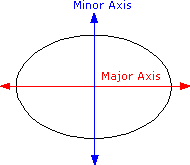
Major Axis of an ellipse is the line passing through the foci, center, and vertices of of the ellipse.
Minor Axis of an ellipse is the line through the center of the ellipse, which is perpendicular to the major axis.
More About Major Axis and Minor Axis
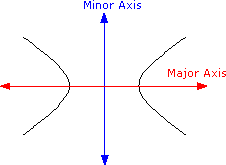
Major Axis of a hyperbola is the line passing through the foci, center, and vertices of the hyperbola.
Minor Axis of a hyperbola is the line through the center of the hyperbola, which is perpendicular to the major axis.
The major and minor axes of an ellipse are its axes of symmetry.
The major and minor axes of a hyperbola are its axes of symmetry.
Video Examples: Ellipses Major and Minor Axis
Examples of Major Axis and Minor Axis
Solved Example on Major Axis and Minor Axis
Ques: Find an equation in standard form for the ellipse whose end points of axes are (± 9, 0) and (0, ± 10).
Choices:
A.
B.
C.
D.
Correct Answer: A
Solution:
Step 1: End points of the axes of the ellipse are (- 9, 0), (9, 0), (0, - 10) and (0, 10).
Step 2: Distance between (- 9, 0) and (9, 0) 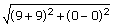 is=18. [Use distance formula.]
Step 3: Distance between (0, - 10) and (0, 10) is 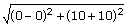 =20. [Use distance formula.]
Step 4: So, the distance between (0, - 10) and (0, 10) is greater than the distance between (- 9, 0) and (9, 0).
Step 5: Hence, the focal axis of the ellipse is y - axis.
Step 6: So, semi-major axis = and semi-minor axis =
  .
.
Step 7: The equation of the ellipse in the standard form is 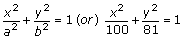 .
.
Quick Summary
- Major axis contains the foci and vertices.
- Minor axis is perpendicular to the major axis at the center.
- For an ellipse, the semi-major axis is 'a' and the semi-minor axis is 'b'.
- For a hyperbola, the distance between vertices is 2a along the major axis.
🍎 Teacher Insights
Use visual aids and real-world examples (e.g., orbits of planets) to illustrate the concepts. Emphasize the importance of correctly identifying the center of the conic section. Provide ample practice problems covering different orientations and equations.🎓 Prerequisites
- Basic algebra
- Coordinate geometry
- Distance formula
- Understanding of ellipses and hyperbolas
Check Your Knowledge
Q1: The endpoints of the major axis of an ellipse are (±5, 0) and the endpoints of the minor axis are (0, ±3). What is the equation of the ellipse?
Frequently Asked Questions
Q: How do I determine which axis is the major axis in an ellipse?
A: The major axis is the longer axis. Look at the equation; the larger denominator corresponds to the major axis.
Q: What is the relationship between the major/minor axis and the foci?
A: The foci always lie on the major axis. Their distance from the center is related to the lengths of the major and minor axes (e.g., c^2 = a^2 - b^2 for an ellipse).