MAGNITUDE OF A VECTOR
Definition Of Magnitude Of A Vector
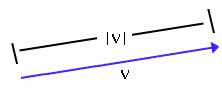
Magnitude of a Vector is the length of the vector.
More About Magnitude of a Vector
The magnitude of a unit vector is 1.
If V is the vector, we denote the length or magnitude of  by |V|.
|V| =  is the formula for finding the magnitude of the vector, where x and y are the components of the vector .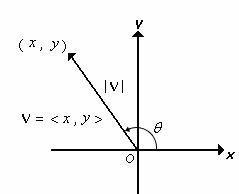
Examples of Magnitude of a Vector
Let =  (2, 3) be a vector. Then the magnitude of is |R| = < x,="" y=""> = =
  =
=  =
=  = . Therefore , is the magnitude of the vector .
Video Examples: CSEC CXC Maths- Finding The Magnitude OF A Vector.
Solved Example on Magnitude of a Vector
Ques: Let u = PQ where P = (12, 12) and Q = (- 9, 40). Which of the following is the magnitude of the vector ?
?
Choices:
A. 21
B. 28
C. 49
D. 35
Correct Answer: D
Solution:
Step 1: u =  , where P = (12, 12) and Q = (- 9, 40).
Step 2: The component form of is = < x 2="" -="" x 1,="" y 2="" -="" y 1=""> = <- 9="" -="" 12,="" 40="" -="" 12=""> = < -="" 21,="" 28="">. [Write the component form of .]
Step 3: The magnitude of is |u| = 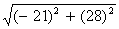 =
=  = 35. [Use the formula to find the magnitude of a vector.]
Quick Summary
- Magnitude is the length of the vector.
- It is always a non-negative value.
- The magnitude of a unit vector is 1.
- The magnitude can be calculated using the formula |V| = sqrt(x^2 + y^2), where x and y are the components of the vector.
🍎 Teacher Insights
Emphasize the connection between the magnitude formula and the Pythagorean theorem. Use visual aids to demonstrate the length of the vector. Provide examples with both 2D and 3D vectors. Relate the concept to real-world applications like velocity and force.🎓 Prerequisites
- Basic Algebra
- Pythagorean Theorem
- Coordinate Geometry
- Vector Components
Check Your Knowledge
Q1: What is the magnitude of the vector <3, 4>?
Q2: If a vector has a magnitude of 1, it is called a:
Q3: The magnitude of a vector is always:
Frequently Asked Questions
Q: What is the magnitude of a zero vector?
A: The magnitude of a zero vector (a vector with all components equal to zero) is zero.
Q: Can the magnitude of a vector be negative?
A: No, the magnitude of a vector represents its length and is always non-negative.
Q: How do I find the magnitude of a 3D vector?
A: For a 3D vector with components (x, y, z), the magnitude is calculated as |V| = sqrt(x^2 + y^2 + z^2).