LINE OF SYMMETRY
Definition Of Line Of Symmetry
Line of symmetry is a line that divides a figure into two congruent parts, each of which is the mirror images of the other.
When the figure having a line of symmetry is folded along the line of symmetry, the two parts should coincide.
Video Examples: Identify Lines of Symmetry
Example of Line of Symmetry
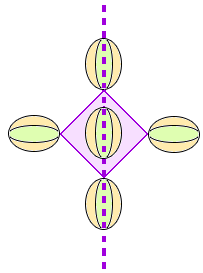
The dotted line shown in the figure is the Line of Symmetry.
Solved Example on Line of Symmetry
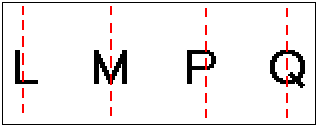
Ques: Among the dotted lines in the figures, which one is a line of symmetry?
Choices:
A. the dotted lines in Figure 2
B. the dotted lines in Figure 3
C. the dotted lines in Figure 1
D. the dotted lines in Figure 4
Correct Answer: A
Solution:
Step 1: Line of Symmetry is a line that divides the figure into two parts, which are mirror image of each other.
Step 2: Among the choices, the dotted line through the letter M divides it into two parts, which are mirror image of each other.
Step 3: The lines passing through the letters L, P, and Q do not divide them into two parts that would be mirror images of each other.
Step 4: So, the dotted line through the letter M is a line of symmetry.
Quick Summary
- A line that divides a shape in half so that both halves are mirror images.
- Folding the shape along the line of symmetry results in the two halves perfectly overlapping.
🍎 Teacher Insights
Use physical objects and folding exercises to help students visualize lines of symmetry. Start with simple shapes and gradually introduce more complex ones.🎓 Prerequisites
- Basic shapes recognition
- Understanding of congruence
Check Your Knowledge
Q1: Which of the following letters has a vertical line of symmetry?
Frequently Asked Questions
Q: What happens if I fold a shape along a line that is NOT a line of symmetry?
A: The two halves will not match up perfectly.
Q: Can a shape have more than one line of symmetry?
A: Yes, some shapes can have multiple lines of symmetry. For example, a square has four lines of symmetry.