LEAST
Definition Of Least
'Least' hints at something that is the smallest in magnitude, amount, or size.
More About Least
The other meaning of least is smallest, shortest, lowest, slightest, tiniest etc.
Video Examples:Least Common Denominator - MathHelp.com
Example of Least
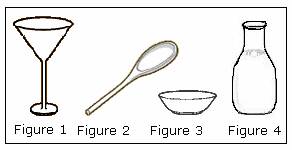
In the above diagram, the object that holds the least amount of fluid is the spoon, i.e. Figure 2.
The least of {56, 78, 54, 21, 63, 5, 9, 24} is 5.
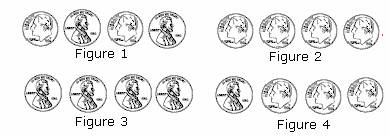
In Figure 1, there are 2 dimes and 2 pennies. So, the value of coins in Figure 1 is 22 cents.
In Figure 2, there are 4 dimes. So, the value of coins in Figure 2 is 40 cents.
In Figure 3, there are 4 pennies. So, the value of coins in Figure 3 is 4 cents.
In Figure 4, there are 3 dimes and 1 penny. So, the value of coins in Figure 4 is 31 cents. So, the Figure 4 has the least value.
Solved Example on Least
Ques: Identify the shape that has the leading entry least number of sides.
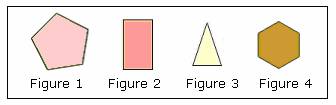
Choices:
A. Figure 1
B. Figure 2
C. Figure 3
D. Figure 4
Correct Answer: C
Solution:
Step 1: The figure with the least number of sides is the one with less number of sides when compared with the other figures.
Step 2: The number of sides in Figures 1, 2, 3, and 4 are 5, 4, 3, and 6 respectively.
Step 3: Therefore, the figure with the least number of sides is Figure 3.
Quick Summary
- 'Least' means the smallest.
- Identifying the 'least' requires comparing multiple values.
- Examples can include amounts, sizes, or numbers.
🍎 Teacher Insights
Use visual aids like blocks or counters to illustrate the concept of 'least'. Provide plenty of hands-on activities comparing different quantities.🎓 Prerequisites
- Counting
- Number recognition
- Basic comparison (greater than, less than)
Check Your Knowledge
Q1: Which number is the least: 3, 7, 1, 5?
Q2: Which group has the least number of items?
Frequently Asked Questions
Q: How is 'least' different from 'less'?
A: 'Least' is used when comparing three or more things. 'Less' is used when comparing only two things.
Q: Can the 'least' value be zero?
A: Yes, zero can be the 'least' value if there are no negative values.