INTERSECTION OF SETS
Definition Of Intersection Of Sets
Intersection of Sets is defined as the grouping up of the common elements of two or more sets.
More About Intersection of Sets
It is denoted by the symbol, n.
Intersection of sets is an associative operation i.e. for three sets
A, B, and C, A n (B n C) = (A n B) n C.
Video Examples: Union and Intersection
Example of Intersection of Sets
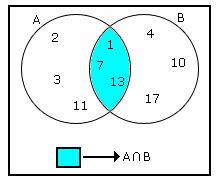
When Set A = {1, 2, 3, 7, 11, 13} and Set B = {1, 4, 7, 10, 13, 17},
A n B is all the common elements of the set A and B.
Therefore, A n B = {1, 7, 13}.
This can be shown by using Venn diagram as:
Solved Example on Intersection of Sets
Ques: Find A n B for the sets: A = {1, 2, 3, 4, 5, 6, 7, 8, 9, 10}; B = {3, 5, 7, 8, 9, 12, 19, 23}.
Choices:
A. A n B = {1, 2, 3, 4, 5, 10}
B. A n B = {3, 4, 5, 6, 23}
C. A n B = {2, 4, 5, 6, 10, 12}
D. A n B = {3, 5, 7, 8, 9}
Correct Answer: D
Solution:
Step 1: The intersection of the two sets A and B is the set of elements common to both the sets.
Step 2: The shaded region in the Venn diagram represents the intersection of the sets A and B.

Step 3: Therefore, A n B = {3, 5, 7, 8, 9}.
Quick Summary
- The intersection of sets contains elements present in all given sets.
- It is denoted by the symbol '∩'.
- A ∩ B represents the intersection of set A and set B.
🍎 Teacher Insights
Use Venn diagrams to visually represent the intersection of sets. Provide real-world examples, such as students who are members of both the math club and the science club.🎓 Prerequisites
- Set
- Element of a Set
- Union of Sets (helpful)
Check Your Knowledge
Q1: What is A ∩ B if A = {1, 2, 3, 4, 5} and B = {3, 5, 7, 9}?
Q2: If A = {a, b, c}, B = {c, d, e}, and C = {b, c, f}, what is A ∩ B ∩ C?
Frequently Asked Questions
Q: What happens if two sets have no elements in common?
A: If two sets have no elements in common, their intersection is the empty set, denoted by ∅ or { }.
Q: Is the order of sets important when finding the intersection?
A: No, the order of sets does not matter. A ∩ B is the same as B ∩ A.