INEQUALITY
Definition Of Inequality
An inequality is a mathematical sentence that uses symbols such as <, ≤,="">, or ≥ to compare two quantities.
Video Examples: How to Solve Inequalities
Example of Inequality
5 < d="">< 7,="" x="" ≥="" -="" 1,="">2 ≤ b, - 12 > - 13 are few examples of inequalities
Solved Example on Inequality
Ques: Pick an appropriate graph for the inequality - 3 < x="" and="" x="">< 2="">
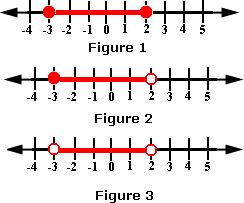
Choices:
A. Figure 1
B. Figure 2
C. Figure 3
D. None of the above
Correct Answer: C
Solution:
Step 1: - 3 < x="">< 2="" [combine="" into="" one="">
Step 2: The compound inequality may be read as 'x is greater than - 3 and less than 2'.
Step 3: The graph of this compound inequality is
 Step 4: So, Figure 3 represents the given inequality.
Quick Summary
- Inequalities compare values.
- They use specific symbols.
- They can be graphed.
🍎 Teacher Insights
Use real-world examples to illustrate inequalities (e.g., speed limits, age restrictions). Emphasize the difference between open and closed circles on a number line when graphing.🎓 Prerequisites
- Number Sense
- Basic Algebra
- Graphing on a Number Line
Check Your Knowledge
Q1: Which symbol represents 'greater than or equal to'?
Q2: Solve for x: x + 3 < 7
Frequently Asked Questions
Q: What does the < symbol mean?
A: The < symbol means 'less than'.
Q: When do I flip the inequality sign?
A: You flip the inequality sign when you multiply or divide both sides by a negative number.