FACTOR TREE
Definition Of Factor Tree
Factor Tree is a hierarchical structure used to represent the prime factors of a number.
More About Factor Tree
All the composite numbers can be written as the product of the prime numbers using the factor tree.
Video Examples:Factor Trees
Example of Factor Tree
To find the prime factors of 66, we use here a factor tree.
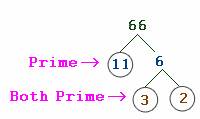
The circled numbers in the factor tree are the prime factors of 66.
66 = 11 × 3 × 2
66 = 111 × 31 × 21 [Write in the form of exponents.]
The prime factorization of 66 is 111 × 31 × 21.
Solved Example on Factor Tree
Ques: Find the prime factorization of 96.
Choices:
A. 31 × 25
B. 31 × 23
C. 32 × 25
D. 32 × 24
Correct Answer: A
Solution:
The factor tree of 96 is: [96 = 24 × 4, 24 = 6 × 4, 4 = 2 × 2, 6 = 3 × 2]

Step 2: The circled numbers in the factor tree are the prime factors of 96.
Step 3: 96 = 3 × 2 × 2 × 2 × 2 × 2 = 31 × 25.
Quick Summary
- A factor tree breaks down a number into its prime factors.
- Composite numbers can be written as a product of prime numbers using a factor tree.
- The prime factorization is the final result of the factor tree.
🍎 Teacher Insights
Use visual aids and manipulatives to help students understand the concept of prime factorization. Encourage students to create their own factor trees for various numbers.🎓 Prerequisites
- Factors
- Prime Numbers
- Composite Numbers
Check Your Knowledge
Q1: What are the prime factors of 66?
Q2: What is the prime factorization of 96?
Frequently Asked Questions
Q: What is a prime factor?
A: A prime factor is a factor that is also a prime number.
Q: How do I know when to stop factoring?
A: Stop when all the factors at the end of each branch are prime numbers.