EQUALITY
Definition Of Equality
Equality is a state in which two things or values are always equal.
More About Equality
In the state of equality, both values on the left and the right side of the sign '=' will be the same.
The equality "A is equal to B" is written as "A = B".
If a number is added on both sides of an equality, then the value of the expression or equation remains the same i.e. if c is any real number, then x + c = y + c
If a number is subtracted from both sides of an equality, then the value of the expression or equation remains the same i.e.if c is any real number, then x - c = y - c
Video Examples:Subtraction Property of Equality
If a number is multiplied on both sides of an equality, then the value of the expression or equation remains the same i.e. if c is any real number, then x.c = y.c
If a number divides both sides of an equality, then the value of the expression or equation remains same i.e. if c is any real number, then
Example of Equality
6 x 8(= 48) is same as 12 x 4(= 48)
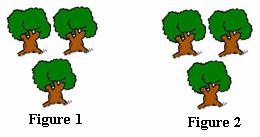
The number of trees in both the figures is equal.
Solved Example on Equality
Ques: Which of the expressions is equal to the expression 6 x 4?
Choices:
A. 7 x 4
B. 8 x 3
C. 9 x 2
D. 3 x 4
Correct Answer: B
Solution:
Step 1: The value of the expression 6 x 4 = 24.
Step 2: Among the given choices, only the value of 8 x 3 = 24.
Step 3: So, the expression 8 x 3 is equal to 6 x 4.
Quick Summary
- Equality means both sides of '=' have the same value.
- Adding or subtracting the same number from both sides maintains equality.
- Multiplying or dividing both sides by the same number maintains equality.
🍎 Teacher Insights
Use visual aids like balances to demonstrate equality. Emphasize the importance of performing the same operation on both sides of an equation.🎓 Prerequisites
- Basic Arithmetic
- Number Recognition
Check Your Knowledge
Q1: Which expression is equal to 6 x 4?
Q2: If a = 5, what is a + 2?
Frequently Asked Questions
Q: What does it mean for two things to be equal?
A: It means they have the same value or amount.
Q: If I add 2 to one side of an equation, what should I do to the other side?
A: You must also add 2 to the other side to keep the equation balanced.