ELLIPSE
Definition Of Ellipse
An Ellipse is a type of conic section that is formed when a cone is cut by a plane.
More About Ellipse
Major axis is the longest segment extending from one end to the other end on an ellipse and always passes through foci.
Minor axis is the line segment perpendicular to major axis, passing through the center of the ellipse and terminates on the ellipse.
Semi-latus rectum is the distance from focus of the ellipse to ellipse itself.
In an ellipse, the locus of all the points on it is at constant distance from two fixed points, which are called the foci of the ellipse
The figure given represents the major axis, minor axis, semi-latus rectum and foci of the ellipse.
Video Examples:Conic Sections: Intro to Ellipses
Example of Ellipse
All the planets move around the sun in elliptical orbits.
Solved Example on Ellipse
Ques: Find the x - intercepts of the ellipse shown.
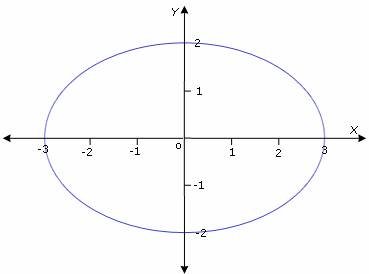
Choices:
A. (- 3, 0), (3, 0)
B. (- 1, 0), (1, 0)
C. (- 2, 0), (2, 0)
D. (0, 2), (0, - 2)
Correct Answer: A
Solution:
Step 1: The ellipse cuts the x - axis at the points (- 3, 0) and (3, 0) which are its x - intercepts.
Quick Summary
- An ellipse has a major axis and a minor axis.
- The foci are two fixed points inside the ellipse.
- The sum of the distances from any point on the ellipse to the two foci is constant.
🍎 Teacher Insights
Use visual aids and real-world examples (like planetary orbits) to help students understand the concept of an ellipse. Emphasize the relationship between the foci, major axis, and minor axis.🎓 Prerequisites
- Basic Geometry
- Coordinate Geometry
- Algebra
Check Your Knowledge
Q1: What is the longest segment extending from one end to the other end on an ellipse and always passes through foci?
Q2: What are the x - intercepts of the ellipse shown in the example?
Frequently Asked Questions
Q: What is the difference between an ellipse and a circle?
A: A circle has a constant radius, while an ellipse has a major and minor axis. A circle is a special case of an ellipse where the major and minor axes are equal.
Q: What are the foci of an ellipse?
A: The foci of an ellipse are two fixed points such that the sum of the distances from any point on the ellipse to the two foci is constant.