DOUBLE NEGATION
Definition Of Double Negation
If the negation is applied twice on a statement, then it is called Double Negation of the statement.
More About Double Negation
Double negation of a statement is the statement itself
Examples of Double Negation
Statement: A rhombus has four equal sides.
Negation: A rhombus does not have four equal sides.
Double Negation: A rhombus has four equal sides.
So, double negation of a statement is equal to the statement itself.
Therefore, ~ (~ p) = p, where p is a statement.
Video Examples: Mulberger: Double Negation
Solved Example on Double Negation
Ques: Which of the following completes the truth table?
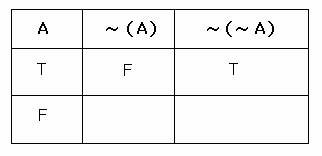
Choices:
A. T and F
B. F and T
C. T and T
D. F and F
Correct Answer: A
Solution:
Step 1: In the second row of the table, it is given that the statement is false (F).
Step 2: Negation of a false statement is true (T) and double negation of a false (F) statement is false (F).
Step 3: So, T and F complete the given truth table.
Quick Summary
- Applying negation twice to a statement returns the original statement.
- Double negation eliminates the need for complex negative phrasing.
- Double negation is a fundamental concept in logic and set theory.
🍎 Teacher Insights
Use real-world examples to illustrate the concept of double negation. Emphasize the equivalence between a statement and its double negation. Provide practice problems to reinforce understanding.🎓 Prerequisites
- Basic logic
- Negation
Check Your Knowledge
Q1: Which of the following is equivalent to 'It is not true that the sky is not blue'?
Q2: What is the double negation of 'x > 5'?
Frequently Asked Questions
Q: What is the purpose of double negation?
A: Double negation can be used to simplify logical expressions or to emphasize a point.
Q: Is double negation always true?
A: Yes, in classical logic, the double negation of a statement is always equivalent to the original statement.