DIVISION PROPERTY OF EQUALITY
Definition Of Division Property Of Equality
Division Property of Equality states that dividing both sides of an equation by a non-zero number doesn't affect the equation
If a, b and c are any three real numbers such that a = b and c ≠ 0 then the division property of equality is a / c = b / c
Examples of Division Property of Equality
5p = 15
By dividing both sides of the equation by 5, we get p = 3.
Substituting p = 3 in the original equation will help us check the division property of equality.
5 x 3 = 15, it's true!
Video Examples: What's the Division Property of Equality?
Solved Example on Division Property of Equality
Solve - 3x = 12 using division property of equality.
Choices:
A. - 4
B. 3
C. 12
D. 36
Correct Answer: A
Solution:
Step 1: - 3x = 12
Step 2: 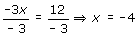 [Apply division property of equality.]
The area of a rectangular plot is 180 sq ft. If its length is 15 ft then what is its width?
Choices:
A. - 4
B. 3
C. 12
D. 36
Correct Answer: A
Solution:
Step 1: Given area of the rectangular plot = 180 sq. ft
Step 2: We know that, area of rectangle = l x w
Step 3: So, l x w =180
Step 4: 15 x w =180 [Substituting l = 15]
Step 5: 15w / 15 = 180 / 15 [Dividing both sides by 15]
Quick Summary
- If two quantities are equal, dividing both by the same non-zero quantity maintains equality.
- This property is used to isolate variables in equations.
🍎 Teacher Insights
Emphasize the importance of performing the same operation on both sides of the equation. Use visual aids to demonstrate the balance of the equation.🎓 Prerequisites
- Basic Algebra
- Solving equations
- Understanding equality
Check Your Knowledge
Q1: Solve for x: 3x = 12
Q2: Using the division property of equality, what is the next step in solving 5x = 25?
Frequently Asked Questions
Q: Why can't I divide by zero?
A: Division by zero is undefined in mathematics. It leads to contradictions and inconsistencies.
Q: When should I use the Division Property of Equality?
A: Use it when you want to isolate a variable that is being multiplied by a coefficient.