DIAGONAL
Definition Of Diagonal
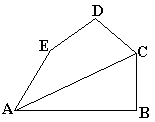
Diagonal is a line segment connecting two non-adjacent vertices of a polygon.
More About Diagonal
The number of diagonals of a polygon of n sides can be found using the formula 
Example of Diagonal
In the example shown, AC is a diagonal.
Video Examples: Diagonal Length
Solved Example on Diagonal
Ques: Justin walked along the diagonal of a square garden of side 20 ft. How far did he walk?
Choices:
A. 29.40 ft
B. 28.40 ft
C. 27.16 ft
D. 28.28 ft
Correct Answer: D
Solution:
Step 1: Side length of the square field is s = 20 ft.
Step 2: Distance that Justin walked = Length of the diagonal of the square field =  = 28.28 ft.
Quick Summary
- A diagonal connects non-adjacent vertices.
- The number of diagonals in a polygon with n sides is n(n-3)/2.
🍎 Teacher Insights
Use visual aids to demonstrate diagonals. Have students draw polygons and their diagonals. Emphasize the difference between adjacent and non-adjacent vertices.🎓 Prerequisites
- Basic understanding of polygons
- Knowledge of vertices and sides
Check Your Knowledge
Q1: How many diagonals does a quadrilateral have?
Q2: A polygon has 5 sides. How many diagonals does it have?
Frequently Asked Questions
Q: What is the difference between a side and a diagonal?
A: A side connects adjacent vertices, while a diagonal connects non-adjacent vertices.
Q: Does a triangle have diagonals?
A: No, a triangle does not have any diagonals because all its vertices are adjacent.