DIAGONAL LINE
Definition Of Diagonal Line
The line joining any two non-adjacent vertices of a polygon is called diagonal line.
More About Diagonal Line
The number of diagonals of a polygon can be calculated using the formula d =  ,
,
where S is the number of sides in the polygon.
The number of diagonals in a polygon with 5 sides =  = 5.
= 5.
Example Of Diagonal Line
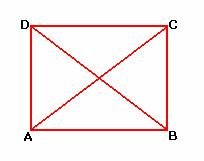
In the given figure, A and C, B and D are the non-adjacent vertices.
The line joining any of these pairs of vertices is called diagonal of the figure.
So, AC and BD are the diagonals of the given figure.
Video Examples: How to Find the Length of a Diagonal Line Running Though a Rectangle : Math Tips
Solved Example on Diagonal Line
Ques: Find the number of diagonals in a regular hexagon.
Choices:
A. 9
B. 6
C. 12
D. 3
Correct Answer: A
Solution:
Step 1: A regular hexagon has all of its sides and angles congruent.
Step 2: Draw the diagonals in a regular hexagon.
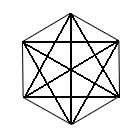 Step 3: 9 diagonals are formed joining the non-adjacent vertices.
Step 4: So, there are 9 diagonals in a regular hexagon.
Quick Summary
- A diagonal connects non-adjacent vertices.
- The number of diagonals in a polygon can be calculated using a formula.
- Different polygons have different numbers of diagonals.
🍎 Teacher Insights
Use visual aids and hands-on activities to help students understand the concept of diagonals. Encourage students to draw diagonals in various polygons to reinforce their understanding.🎓 Prerequisites
- Basic understanding of polygons
- Knowledge of vertices and sides
Check Your Knowledge
Q1: How many diagonals does a quadrilateral have?
Q2: A polygon has 5 sides. How many diagonals does it have?
Frequently Asked Questions
Q: What is a vertex?
A: A vertex is a point where two or more line segments meet.
Q: Can a triangle have diagonals?
A: No, a triangle does not have any non-adjacent vertices, so it cannot have any diagonals.