CYCLIC QUADRILATERAL
Definition Of Cyclic Quadrilateral
If a quadrilateral has all of its vertices lying on a circle, then it is known as a Cyclic Quadrilateral.
More About Cyclic Quadrilateral
In a cyclic quadrilateral:
1. Opposite angles are supplementary.
2. Exterior angles are equal to the opposite interior angles.
3. The product of the two diagonals is equal to the sum of the products of opposite sides.
Video Examples: Proof Cyclic Quadrilaterals
Example of Cyclic Quadrilateral
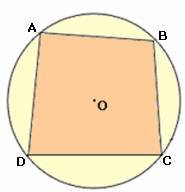
In the given figure, quadrilateral ABCD is inscribed in a circle, so it is a cyclic quadrilateral.
Solved Example on Cyclic Quadrilateral
Ques: In the cyclic quadrilateral PQRS, ÐP = 60°, ÐQ = 70°. Find ÐR and ÐS.
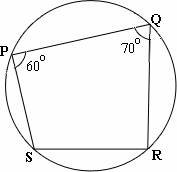
Choices:
A. ÐR = 120° and ÐS = 110°
B. ÐR = 60° and ÐS = 70°
C. ÐR = 90° and ÐS = 90°
D. ÐR = 110° and ÐS = 120°
Correct Answer: A
Solution:
Step 1: In a cyclic quadrilateral, opposite angles are supplementary.
Step 2: ÐP and ÐR are supplementary, so ÐP + ÐR = 1800 þ ÐR = 1800 - 600 = 1200
Step 3: ÐQ and ÐS are supplementary, so ÐQ + ÐS = 1800 þ ÐS = 1800 - 700 = 1100
Step 4: So, ÐR = 120° and ÐS = 110°.
Quick Summary
- All vertices lie on a circle.
- Opposite angles are supplementary (add up to 180 degrees).
- An exterior angle is equal to the opposite interior angle.
- Ptolemy's Theorem applies: The product of the diagonals equals the sum of the products of opposite sides.
🍎 Teacher Insights
Use dynamic geometry software to allow students to explore cyclic quadrilaterals and verify properties. Emphasize the converse of the properties to help students determine if a quadrilateral is cyclic.🎓 Prerequisites
- Quadrilaterals
- Circles
- Angles
- Supplementary Angles
Check Your Knowledge
Q1: In cyclic quadrilateral ABCD, if angle A is 80 degrees, what is the measure of angle C?
Q2: Which of the following is NOT a property of a cyclic quadrilateral?
Frequently Asked Questions
Q: Are all quadrilaterals cyclic?
A: No, only quadrilaterals whose vertices all lie on a single circle are cyclic.
Q: What is the relationship between opposite angles in a cyclic quadrilateral?
A: Opposite angles in a cyclic quadrilateral are supplementary; that is, they add up to 180 degrees.