CONE
Definition Of Cone
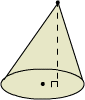
Cone is a three-dimensional figure that has one circular base and one vertex.
More About Cone
Right Cone: A right cone is a cone in which the vertex is aligned directly above the center of the base. The base need not be a circle here.
Right Circular Cone: When the base of a right cone is a circle, it is called a right circular cone. In a right circular cone, each point on the circle is equidistant from the vertex of the cone.

Oblique Cone: When the vertex of a cone is not aligned directly above the center of its base, it is called an oblique cone.
Video Examples: Volume Of A Cone
Solved Example on Cone
Ques: Find the base area of a cone of height 5 units and base radius 2 units.
Choices:
A. 5
B. 2
C. 4
D. 12.57
Correct Answer: D
Solution:
Step 1: The base radius is 2 units.
Step 2: So, the area of the base is π × 2 × 2 = 12.57 sq units.
Quick Summary
- A cone has a circular base and a vertex.
- A right cone has its vertex directly above the center of the base.
- An oblique cone has its vertex not aligned above the center of the base.
- The volume of a cone is one-third the area of the base times the height.
🍎 Teacher Insights
Use physical models to demonstrate right and oblique cones. Emphasize the relationship between cones and cylinders to help students remember the volume formula.🎓 Prerequisites
- Circles
- Area of a Circle
- Three-Dimensional Shapes
- Pythagorean Theorem
Check Your Knowledge
Q1: What is the area of the base of a cone with a radius of 2 units?
Q2: Which of the following describes a right cone?
Frequently Asked Questions
Q: What is the difference between a right cone and an oblique cone?
A: In a right cone, the vertex is directly above the center of the base, while in an oblique cone, the vertex is not.
Q: How do you calculate the surface area of a cone?
A: The surface area of a cone is calculated as the sum of the base area and the lateral surface area, which can be calculated using the slant height.