COMMON EXTERNAL TANGENT
Definition Of Common External Tangent
A tangent that is common to two circles and does not intersect the segment joining the centers of the circles is called Common External Tangent.
More About Common External Tangent
A common tangent can either be a common external tangent or a common internal tangent.
Video Examples:How to Construct a Common Tangent of Two Circles : Math Instructi
Example of Common External Tangent

In the above figure, line PQ is the common external tangent.
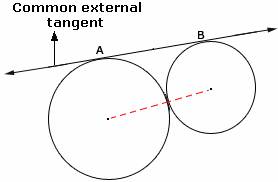
In the above figure, line AB is the common external tangent.
Solved Example on Common External Tangent
Ques: Identify the common external tangent from the given figure.

Choices:
A. AB
B. CD
C. EF
D. none of the above
Correct Answer: B
Solution:
Step 1: A tangent that is common to two circles and does not intersect the segment joining the centers of the circles is called common external tangent.
Step 2: In the given figure, the line CD touches both the circles on the same side of the line is the external tangent to the circle.
Step 3: So, CD is the common external tangent line.
Quick Summary
- A common external tangent touches two circles.
- It does not intersect the line segment connecting the centers of the two circles.
- It is different from a common internal tangent.
🍎 Teacher Insights
Use physical models of circles and strings to demonstrate common tangents. Emphasize the difference between internal and external tangents with visual aids.🎓 Prerequisites
- Tangent lines
- Circles
- Line segments
- Intersection
Check Your Knowledge
Q1: Which of the following describes a common external tangent?
Q2: In the diagram, line CD is a common tangent to circles A and B. If CD does not intersect line AB, then it is a...
Frequently Asked Questions
Q: How many common external tangents can two circles have?
A: Two circles can have at most four common tangents. They can have two common external tangents if they do not intersect and two internal tangents.
Q: What is the relationship between the radius and the tangent at the point of tangency?
A: The radius is perpendicular to the tangent at the point of tangency.