BISECTOR OF A LINE
Definition Of Bisector Of A Line
A line that cuts another line segment into two equal parts is called the Bisector of that line segment.
More About Bisector of a Line
The right bisector of a line segment is a line that intersects the line segment at its midpoint at 900 angle.
Video Examples: Bisector of a Line
Example of Bisector of a Line
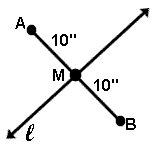
In the above figure, line l is the bisector of  at M.
at M.
Solved Example on Bisector of a Line
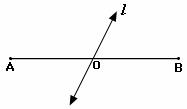
Ques: What is the length of AB, if line l is the segment bisector and AO = 6 units?
Choices:
A. 13 units
B. 6 units
C. 12 units
D. 14 units
Correct Answer: C
Solution:
Step 1: Line l divides AB into two equal parts and O is the midpoint of AB
[Since a segment bisector is a line passing through the midpoint of the segment.]
Step 2: AB = 2(AO) = 2(6) units = 12 units [Substitute AO = 6.]
Step 3: The length of AB is 12 units.
Quick Summary
- A bisector divides a line segment into two congruent segments.
- A right bisector intersects the line segment at a 90-degree angle.
🍎 Teacher Insights
Use visual aids and hands-on activities like paper folding to demonstrate the concept of a bisector. Emphasize the difference between a bisector and a right bisector.🎓 Prerequisites
- Understanding of line segments
- Concept of midpoint
- Basic angle measurement
Check Your Knowledge
Q1: Line l bisects segment AB at point M. If AM = 5 cm, what is the length of AB?
Q2: Which of the following is NOT a property of a bisector?
Frequently Asked Questions
Q: What is the difference between a bisector and a right bisector?
A: A bisector simply divides a line segment into two equal parts. A right bisector does that and also forms a 90-degree angle with the line segment at the point of intersection.
Q: Can a line segment have more than one bisector?
A: Yes, a line segment can have infinitely many bisectors. But only one right bisector.