ASCENDING ORDER
Definition Of Ascending Order
Ascending order is arranging the numbers from the smallest to the largest.
Examples of Ascending Order

The numbers in the above figure are in ascending order as the numbers are arranged from the least to the greatest.
We can arrange the decimals 3.60, 2.75, 5.25 in ascending order with the help of number line.
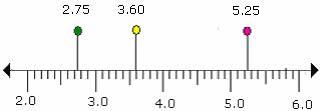
As the numbers in the number line are arranged from the least to the greatest, the numbers in ascending order are 2.75, 3.60, and 5.25.
The ascending order for the data set 23, 16, 9, 2, and 30 is 2, 9, 16, 23, and 30 as 2 < 9="">< 16="">< 23=""><>
Video Examples: Arrange in Descending Order.wmv
Solved Example on Ascending order
Ques: The points obtained by four students in an examination are 137, 123, 148, and 146. Arrange their points in the ascending order.
Choices:
A. 123 < 137="">< 146=""><>
B. 148 < 146="">< 137=""><>
C. 146 < 123="">< 137=""><>
D. 137 < 148="">< 146=""><>
Correct Answer: A
Solution:
Step 1: When numbers are arranged from the lowest to the greatest, the order is called ascending order.
Step 2: The points obtained by four students are 137, 123, 148, and 146.
Step 3: To compare numbers, always begin with the greatest place and compare the digits.
Step 4:
H T O
1 3 7
1 2 3
1 4 8
1 4 6
Step 5: All the digits in the hundreds place are same. [Compare.]
Step 6: 2 < 3="">< 4="4" [compare="" the="" digits="" in="" the="" tens="">
Step 7: So, 123 <>
Step 8:6 < 8="" [compare="" the="" digits="" in="" the="" ones="" place="" of="" the="" numbers="" 146="" and="">
Step 9: So, 146 <>
Step 10: The ascending order of their points is 123 < 137="">< 146="">< 148.="">
Quick Summary
- Ascending order means arranging numbers from least to greatest.
- We compare the values of numbers to place them in ascending order.
- Number lines can be used to visualize ascending order.
🍎 Teacher Insights
Use visual aids like number lines and blocks to help students understand the concept. Provide plenty of practice exercises with different types of numbers (whole numbers, decimals, fractions).🎓 Prerequisites
- Counting
- Number Recognition
- Comparison of Numbers
Check Your Knowledge
Q1: Which of the following is in ascending order?
Q2: Arrange the numbers 7, 2, 9, 1 in ascending order.
Frequently Asked Questions
Q: What is ascending order?
A: Ascending order means arranging numbers from the smallest value to the largest value.
Q: How do I arrange decimals in ascending order?
A: Compare the whole number parts first. If they are the same, compare the tenths place, then the hundredths place, and so on.