AREA OF A POLYGON
Definition Of Area Of A Polygon
Area of a Polygon is the amount of space or region occupied by that polygon.
More About Area of a Polygon
The area of an irregular polygon can be found by dividing it into different standard polygons.
Area of a square = s2
Area of a rectangle = lb
Area of a triangle =  bh
bh
Area of a parallelogram = bh
Area of a trapezoid =  (
( )
)
Examples of Area of a Polygon
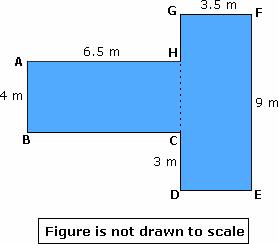
Area of the figure = Area of rectangle ABCH + Area of rectangle DEFG = AH × AB + DE × EF = (6.5 × 4 + 3.5 × 9) m2 = 57.5 m2.
So, the area of the above irregular polygon is 57.5 m2
Video Examples: Area of Polygons
Solved Example on Area of a Polygon
Ques:
Find the area of the figure.
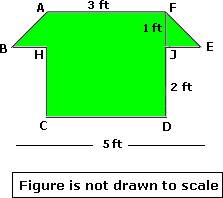
Choices:
A. 14 ft2
B. 11 ft2
C. 12 ft2
D. 10 ft2
Correct Answer: D
Solution:
Step 1: The figure is divided into a trapezoid and a rectangle.
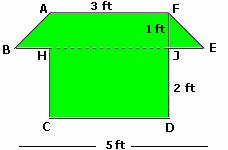 Step 2: Area of the figure = Area of trapezoid ABEF + Area of rectangle HCDJ
Step 3: = × FJ × (AF + BE) + HC × CD
Step 4: = × 1 × (3 + 5) + 2 × 3 = 10 [Substitute the values.]
Step 5: Therefore, area of the figure is 10 ft2.
Quick Summary
- Area of a polygon is the measure of the surface it covers.
- Irregular polygons can be divided into standard polygons to calculate the total area.
- Formulas exist for calculating the area of regular polygons like squares, rectangles, triangles, parallelograms, and trapezoids.
🍎 Teacher Insights
Use visual aids and hands-on activities to demonstrate how to divide irregular polygons into regular shapes. Provide plenty of practice problems with varying levels of difficulty. Emphasize the importance of labeling units correctly.🎓 Prerequisites
- Basic arithmetic
- Understanding of geometric shapes (squares, rectangles, triangles, parallelograms, trapezoids)
- Concept of area
Check Your Knowledge
Q1: What is the area of a rectangle with length 5 cm and width 3 cm?
Q2: A square has a side length of 4 inches. What is its area?
Frequently Asked Questions
Q: How do you find the area of an irregular polygon?
A: Divide the irregular polygon into smaller, regular polygons (e.g., rectangles, triangles). Calculate the area of each regular polygon and then add the areas together.
Q: What is the difference between area and perimeter?
A: Area is the measure of the surface enclosed by a shape, while perimeter is the total length of the sides of the shape.
Q: Why is area measured in square units?
A: Area is measured in square units because it represents the number of squares of a certain size (e.g., 1x1 meter) that are needed to cover the surface.