APPROXIMATE
Definition Of Approximate
Approximate is an estimation of a number or rounding a number to its nearest place value.
More About Approximate
For a number that ends with a digit less than 5: Round down the number to the lower number that ends with 0.
For a number that ends with a digit greater than or equal to 5: Round up the number by adding 1 to that digit.
Examples of Approximate
234 rounded to the nearest tens is 230: As the digit in the ones place is less than 5, we round down the number to 0.
4589 rounded to the nearest hundreds is 4600: As the digit in the hundreds place is 5, so we round up the number by adding 1 to that digit.
Video Examples: Simpsons Rule - Approximate Integration
Solved Example Clockple on Approximate
Ques: Justin earns $8,265 and saves $3,325 every month. Estimate the amount of money, which he spends every month, to the nearest hundred
Choices:
A. $5,300
B. $6,000
C. $4,000
D. $5,000
Correct Answer: D
Solution:
Step 1: Justin's earnings = $8,265
Step 2: 8,265 ∼ 8,300 [Round to the nearest hundreds.]
Step 3: Justin's savings = $3,325
Step 4: 3,325 ∼ 3,300 [Round to the nearest hundreds.]
Step 5: 8,300 - 3,300 = 5,000 [Total earnings - Total savings = Expenditure.]
Step 6: Justin spends about $5,000 every month.
Ques: Victor deposited $38,450 into his account. What is the amount in his account rounded to the nearest ten thousands?
Choices:
A. $50,000
B. $40,000
C. $30,000
D. $3000
Correct Answer: B
Solution:
Step 1: Represent the number 38,450 on a number line as shown below.
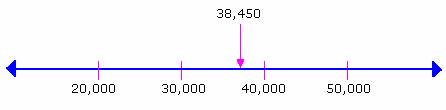
Step 2: On the number line, 38,450 is between 30,000 and 40,000.
Step 3: The number 38,450 is closer to 40,000 than to 30,000.
Step 4: So, 38,450 rounded to its nearest ten thousands is 40,000.
Quick Summary
- Approximation involves rounding numbers.
- Numbers ending in digits less than 5 are rounded down.
- Numbers ending in digits 5 or greater are rounded up.
🍎 Teacher Insights
Use real-world examples to illustrate approximation, such as estimating grocery bills or travel distances. Use a number line to visually represent rounding.🎓 Prerequisites
- Place Value
- Number Recognition
- Basic Arithmetic
Check Your Knowledge
Q1: What is 47 rounded to the nearest ten?
Q2: What is 123 rounded to the nearest hundred?
Frequently Asked Questions
Q: What does it mean to round to the nearest ten?
A: It means to find the multiple of 10 that the number is closest to. For example, 23 rounded to the nearest ten is 20, and 27 rounded to the nearest ten is 30.
Q: Why do we use approximation?
A: Approximation makes numbers easier to work with and understand, especially in estimations and quick calculations.