ANGLE OF ELEVATION
Definition Of Angle Of Elevation
The word "elevation" means "rise" or "move up".
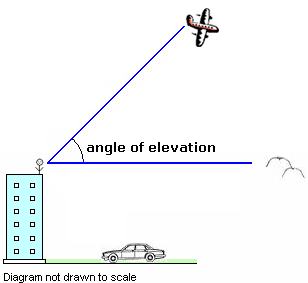
Angle of elevation is the angle between the horizontal and the line of sight to an object above the horizontal.
Take a look at the example below.
Examples of Angle of Elevation
IIn the picture below, an observer is standing at the top of a building and looking straight ahead at the birds (horizontal line). The observer must raise his eyes to see the airplane (slanting line).
The angle formed between the two lines is called the angle of elevation.
Video Examples: Angles of Elevation
Solved Example Clockple on Angle of Elevation
Ques: The angle of elevation of the top of a pole measures 480 from a point on the ground 18 ft away from its base. Find the height of the flagpole.
Solution:
Step 1: Let's first visualize the situation.

Step 2: Let 'x' be the height of the flagpole.

Step 4: x = 18 × tan 480 = 18 × 1.11061 = 19.99102...>> 20
Step 5: So, the flagpole is about 20 ft high.
Quick Summary
- Angle of elevation is the angle formed when an observer looks upward to an object.
- It is always measured from the horizontal line of sight.
- Trigonometric ratios (tan, sin, cos) are used to solve problems involving angle of elevation.
🍎 Teacher Insights
Use real-world examples (e.g., height of a building, distance to an airplane) to illustrate the concept. Encourage students to draw diagrams to visualize the problem. Emphasize the importance of correctly labeling the sides of a right triangle.🎓 Prerequisites
- Right Triangles
- Trigonometric Ratios (SOH CAH TOA)
- Horizontal and Vertical Lines
Check Your Knowledge
Q1: The angle of elevation to the top of a tower from a point 50 meters away from its base is 60 degrees. Find the height of the tower.
Q2: An observer is standing at the top of a building. The angle of elevation to an airplane is 30 degrees, what can we assume?
Frequently Asked Questions
Q: What is the difference between angle of elevation and angle of depression?
A: Angle of elevation is measured upwards from the horizontal, while angle of depression is measured downwards from the horizontal.
Q: How do you find the angle of elevation?
A: Use trigonometric ratios (SOH CAH TOA) to relate the angle to the sides of a right triangle formed by the horizontal distance, vertical height, and line of sight.