ANGLE OF DEPRESSION
Definition Of Angle Of Depression
The word "depression" means "fall" or "drop".
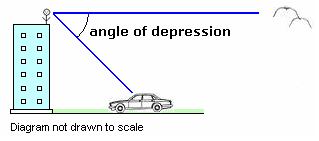
Angle of depression is the angle between the horizontal and the line of sight to an object beneath the horizontal.
Take a look at the example below.
Examples of Angle of Depression
In the picture below, an observer is standing at the top of a building and looking straight ahead at the birds (horizontal line). The observer must lower his eyes to see the car parked (slanting line).
The angle formed between the two lines is called the angle of depression.
Video Examples: How to Solve Trig Application Problems: Angle of Depression
Solved Example Clockwise on Angle of Depression
Ques: An airplane is flying at a height of 2 miles above the level ground. The angle of depression from the plane to the foot of a tree is 15o. Find the distance that the air plane must fly to be directly above the tree.
Solution:
Step 1: Let's first visualize the situation.

Step 2: Let 'x' be the distance the airplane must fly to be directly above the tree.
Step 3: The level ground and the horizontal are parallel, so the alternate interior angles are equal in measure.


Step 6: So, the airplane must fly about 7.46 miles to be directly above the tree.
Quick Summary
- The angle of depression is measured downwards from the horizontal.
- It's often used in problems involving heights, distances, and angles.
- It forms a right triangle with the height and horizontal distance.
🍎 Teacher Insights
Use real-world examples, such as looking down from a building or airplane, to illustrate the concept. Draw clear diagrams and emphasize the importance of correctly labeling the sides of the right triangle.🎓 Prerequisites
- Right triangle trigonometry
- SOH CAH TOA
- Angles and parallel lines
Check Your Knowledge
Q1: An airplane is flying at an altitude of 1000 meters. The angle of depression to a landmark on the ground is 30 degrees. What is the horizontal distance from the airplane to the landmark?
Frequently Asked Questions
Q: What is the relationship between angle of depression and angle of elevation?
A: When looking at the same object, the angle of depression from one point is equal to the angle of elevation from the other point if the horizontal lines are parallel.
Q: How do I identify the angle of depression in a word problem?
A: Look for phrases like 'looking down at' or 'observing from above'. The angle will be formed below a horizontal line.