ADJACENT ANGLES
The word "adjacent" means "next" or "neighboring"
Adjacent angles are angles just next to each other. Adjacent angles share a common vertex and a common side, but do not overlap.
More about Adjacent Angles
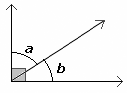
If two adjacent angles form a right angle (90o), then they are complementary
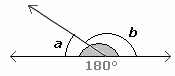
If two adjacent angles form a straight angle (180o), then they are supplementary.
Examples of Adjacent Angles
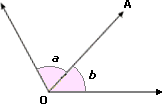
In the figure shown, a and b are adjacent angles. They have a common vertex O and a common side OA.
Video Examples: Adjacent Angles
Solved Example on Adjacent Angles
Name all pairs of angles in the diagram that are adjacent.
Solution:
Adjacent angles are angles just next to each other. Adjacent angles share a common vertex and a common side, but do not overlap.
∠a and ∠b,
∠b and ∠c
∠c and ∠d
∠d and ∠e
∠e and ∠a are the pairs of adjacent angels in the diagram shown above.
∠BAC and ∠CAD are adjacent angles. Find m∠CAD, if m∠BAC = 32o and m∠DAB = 58o.
Solution:
Step 1: Lets first draw the figure.
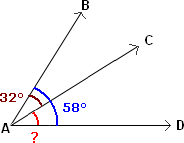
Step 2: ∠BAC and ∠CAD are adjacent angles.
⇒ m∠DAB = m∠BAC + m∠CAD
⇒ m∠CAD = m∠DAB ∠ m∠BAC
Step 3: = 58o - 32o = 26o
Step 4: So, m∠CAD = 26o
Quick Summary
- Adjacent angles are next to each other.
- They share a common vertex.
- They share a common side.
- They do not overlap.
🍎 Teacher Insights
Use visual aids and real-world examples to illustrate the concept of adjacent angles. Emphasize the importance of the shared vertex and side. Have students draw and identify adjacent angles in various diagrams.🎓 Prerequisites
- Basic angle definitions
- Vertex
- Sides of an angle
Check Your Knowledge
Q1: Which of the following describes adjacent angles?
Q2: If angle A and angle B are adjacent and form a right angle, what is their relationship?
Frequently Asked Questions
Q: Are all angles that share a vertex adjacent?
A: No, they must also share a common side and not overlap.
Q: Can adjacent angles form a straight line?
A: Yes, if the non-common sides of the adjacent angles form a straight line, they are supplementary angles and their measures add up to 180 degrees.