ADDITION OF VECTORS
Adding two or more vectors to form a single resultant vector is known as Addition of Vectors.
More about Addition of Vectors
If two vectors have the same direction, then the sum of these two vectors is equal to the sum of their magnitudes, in the same direction.
If the two vectors are in opposite directions, then the resultant of the vectors is the difference of the magnitude of the two vectors and is in the direction of the greater vector.
Examples of Addition of Vectors
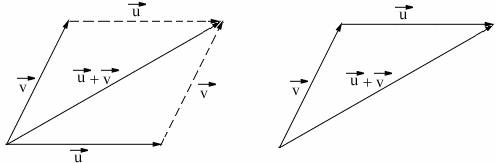
To find the sum of the vectors of  and,
and, they are placed tail to tail to form two adjacent sides of a parallelogram and the diagonal
  gives the sum of the vectors
  and
and . This is also called as 'parallelogram rule of vector addition'.
If the vector is represented in Cartesian coordinate, then the sum of the vectors is found by adding the vector components.
The sum of the vectors u = <- 3,="" 4=""> and v = <4, 6=""> is
u + v = <- 3="" +="" 4,="" 4="" +="" 6="">
= <1, 10="">
Video Examples: Addition Of Vectors
Solved Example on Addition of Vectors
Let = <- 5,8=""> and = <8, 10="">. Which of the following is the component form of the vector
+ ?
Choices:
A. <3, 18="">
B. <18, 13="">
C. <13, 18="">
D. <18, 3="">
Correct Answer: A
Solution:
Step 1: = <- 5,="" 8=""> and = <8, 10="">
Step 2: +
= <- 5,="" 8=""> + <8, 10=""> [Use the definition of sum of vectors.]
Step 3: = <- 5="" +="" 8,="" 8="" +="" 10="">
Step 4: = <3, 18="">
Quick Summary
- Vectors in the same direction add arithmetically.
- Vectors in opposite directions subtract, with the resultant in the direction of the larger vector.
- Vector addition can be visualized using the parallelogram rule.
- In Cartesian coordinates, add vectors by summing their components.
🍎 Teacher Insights
Use visual aids like arrows and diagrams to illustrate vector addition. Emphasize the importance of direction. Provide real-world examples such as forces and velocities.🎓 Prerequisites
- Basic Algebra
- Coordinate Systems
- Trigonometry
Check Your Knowledge
Q1: If vector A = <-5, 8> and vector B = <8, 10>, what is A + B?
Q2: Two vectors of magnitudes 3 and 4 act perpendicularly. What is the magnitude of the resultant vector?
Frequently Asked Questions
Q: How do you add vectors graphically?
A: Using the head-to-tail method or the parallelogram rule.
Q: What is a resultant vector?
A: The single vector that results from adding two or more vectors.