CUBOID
Definition Of Cuboid
Cuboid is a polyhedron with six rectangular plane faces.
More About Cuboid
There are 12 edges and 8 vertices in a cuboid.
Cuboid is also called as right rectangular prism or rectangular parallelepiped box.
If all the edges of a cuboid are equal then it forms a cube.
In a cuboid opposite faces are equal and parallel and all angles are right angles.
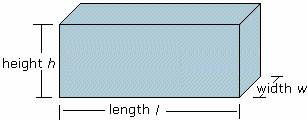
Formulas for the above rectangular box:
Volume = lwh
Lateral Surface Area = 2lh + 2wh
Surface Area = 2lw + 2lh + 2wh
Video Examples: Surface Area of a Cuboid - Mathematics
Example of Cuboid
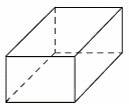
The above figure is a rectangular prism having six rectangular faces with the opposite faces being parallel.
Solved Example on Cuboid
Ques: Which net can be folded to form a cuboid?
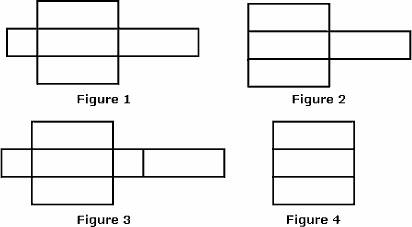
Choices:
A. Figure 1
B. Figure 2
C. Figure 3
D. Figure 4
Correct Answer: C
Solution:
Step 1: A cuboid is a polyhedron with six rectangular plane faces.
Step 2: Observe the nets given in the four figures. [Cut a paper into the shape of net and fold it.]
Step 3: We observe that a cuboid is formed only from the net in Figure 3.
Step 4: The net in the Figure 3 can be folded to form a cuboid.
Quick Summary
- Cuboids have 6 rectangular faces, 12 edges, and 8 vertices.
- Opposite faces of a cuboid are equal and parallel.
- A cube is a special type of cuboid where all edges are equal.
⚠️ Common Mistakes
- Confusing cuboids with cubes.
- Incorrectly applying volume or surface area formulas.
🌍 Real-World Uses
- Shipping boxes: Cuboids are commonly used for packaging and transporting goods.
- Buildings: Many buildings are cuboid-shaped or composed of cuboid sections.
- Aquariums: Rectangular aquariums are cuboids, allowing for easy volume calculation.
📋 Standards Alignment
CCSS.MATH.CONTENT.6.G.A.2CCSS.MATH.CONTENT.7.G.B.6
🔗 Related Links
🍎 Teacher Insights
Use real-world examples like boxes and bricks to illustrate the properties of cuboids. Hands-on activities with nets are helpful.🎓 Prerequisites
- Basic shapes (rectangle, square)
- Area and Volume concepts
Check Your Knowledge
Q1: Which of the following is NOT a property of a cuboid?
Q2: If a cuboid has length 5cm, width 3cm, and height 2cm, what is its volume?
Frequently Asked Questions
Q: Is a cube a cuboid?
A: Yes, a cube is a special case of a cuboid where all sides are equal.
Q: What is the difference between a cuboid and a rectangular prism?
A: They are the same thing. Cuboid is also called a right rectangular prism or rectangular parallelepiped box.